 Peru
1.3 Million Tablets, and Finally, Connected Classrooms
How Korea's Knowledge Sharing Program (KSP) Transformed Education in Peru
2026. 08. 31
| Project name | Establishing ICT Policy in Education of Peru |
|---|---|
| Project year | 2019/20 |
| Country | Peru |
| ODA status | ODA |
| Project type | Policy consultation |
| Implementation method | Direct |
| Lead implementing organization | KDI |
| Local counterpart ministry | Ministry of Education |
How Korea's Knowledge Sharing Program (KSP) Transformed Education in Peru
A tablet arrived at a rural school in Peru. At first, it was a place the internet couldn't reach. But a few years later, that classroom became a node in a nationwide digital education network. This is the story of how a single device sparked a change that grew into a system.
Why Peru — Low Investment, Wide Gaps
Peru's rate of investment in education fell well short of the OECD average, and the country ranked among the lowest performers in the Programme for International Student Assessment (PISA). Budget wasn't the only issue. Structural problems were deeply intertwined: the gap in academic achievement and enrollment rates between Lima and the provinces, a chronic shortage of teachers, and a multilingual, multicultural environment shaped by numerous regional languages.
Even so, Peru had already accumulated experience in educational informatization as a founding country of One Laptop Per Child (OLPC). Peru's Ministry of Education had established a national strategy for digital technology, but lacked the capacity to execute it. A country with experience, but no momentum to act — this is where Korea's Knowledge Sharing Program (KSP) began.
Tablets Without Connection — What the Pandemic Revealed
This KSP, launched in 2019 at the request of Peru's Ministry of Education, was an effort to jointly draw up a master plan for the digital transformation of public education. Then, in 2020, in the middle of the project, COVID-19 struck the world. Schools closed and field research came to a halt — but paradoxically, the pandemic laid bare the real problems in Peruvian education.
Remote schools in the Andes and the Amazon had no internet connection at all, and both teachers and students lacked the capacity to use digital devices. It became clear that no matter how many devices were distributed, they would be useless without connectivity and the human capacity to use them.
A Blueprint Built on Three Pillars — Infrastructure, People, Systems
The KSP research team (Korean and Peruvian experts) brought the problem together under a single lens. Rather than simply distributing devices, they proposed connecting three pillars — infrastructure, digital literacy, and administrative systems — into one integrated structure.
 Master Plan
Designing a Peru-specific ICT infrastructure strategy by benchmarking Korea's experience in informatization
Proposing a competency framework and curriculum so teachers and students could actually put technology to use
Presenting a plan for digitally integrating Peru's education administration, based on Korea's NEIS (National Education Information System)
The core of this project was producing actionable recommendations that aligned with the Peruvian government's policy direction, while also factoring in World Bank (WB) projects and KOICA's ongoing initiatives.
Five Years Later, How Much Has the Classroom Changed? — 2025 Mid-Term Outcome Monitoring
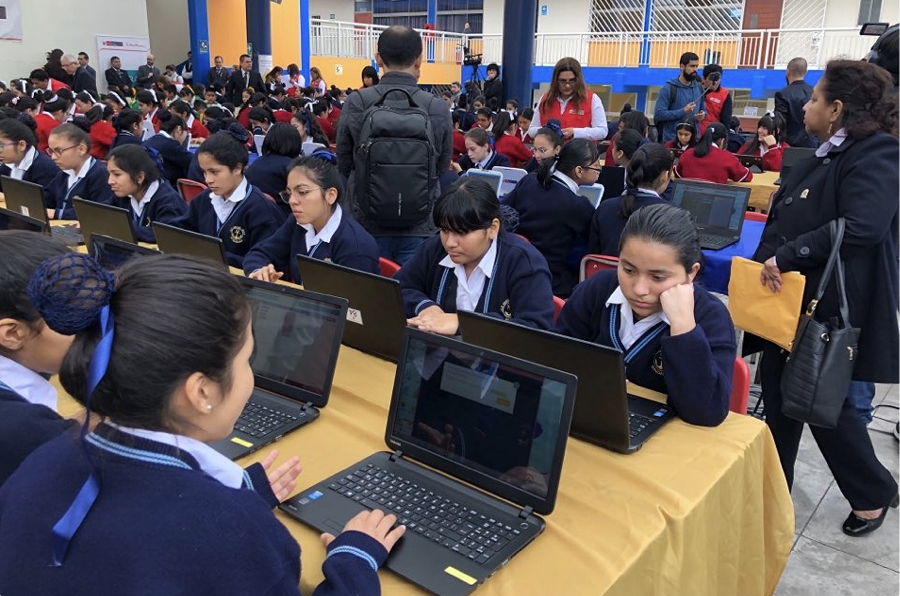
1.3 million tablets reached 32,000 schools.
Between 2019 and 2022, the Peruvian government rapidly expanded digital access, prioritizing rural areas and low-income students. About 75% of all teachers — 300,000 in total — completed digital competency training, which was later followed up with an ongoing online education system.
The most notable change was institutionalization. Based on KSP's recommendations, Peru's Ministry of Education formalized ICT adoption guidelines covering infrastructure, teacher capacity, and administrative systems through "Resolution 234-2021." Digital literacy has since become a core pillar of education policy, and work to integrate administrative information systems is underway.
Of course, challenges remain: insufficient budget for internet networks, frequent turnover of ministers and vice-ministers, and delays in administrative procedures. Still, the direction set by KSP has carried forward into the subsequent "2030 Digital Transformation Plan," and continues to serve as a living reference for the Peruvian government.
| Partner country | Peru | |
|---|---|---|
| Project year | 2019/20 | |
| Baseline (policy issue) | Education digitalization was at an early stage, marked by insufficient digital infrastructure, inadequate teacher capacity, and the absence of an administrative system | |
| Mid-term outcome |
Enactment of the '234-2021' ICT guideline; digital literacy reflected in national strategy Distribution of 1.3 million tablets; digital training completed for 300,000 teachers Education data integration and a 7-stage implementation plan established |
|
| Outcome classification | Major category | Partner country's own policy reflection |
| Sub category |
Policy documents, budget formulation Other (capacity building) Policy implementation, practical utilization |
|
| Evidence level | Reliability | High |
| Contribution | High | |
| Mid-term outcome assessment | Effectiveness | High |
| Consistency | High | |
| Sustainability | Moderate | |