 Indonesia
's Journey Toward a Battery Circular Economy
Transplanting the Blueprint for "Korean-Style Resource Circulation" into the Heart of the Rapidly Growing EV Sector
2026. 08. 07
The Approaching Future: The Booming EV Market and the "Battery Time Loop"
Under its grand national vision of achieving Net Zero by 2060, Indonesia is staking its future on the electrification of mobility. The newly inaugurated Prabowo administration has also set an ambitious goal of producing 2.5 million electric vehicles by 2030. Driven by strong government incentives and a massive influx of affordable Chinese EV models, Indonesia's EV sales surged from a mere 125 units in 2020 to 43,188 units in 2024—a staggering jump of over 153%.
 Battery Lifespan
Behind the rapid adoption of electric vehicles lies a critical challenge: given the average EV battery lifespan of 7 to 10 years, replacement time for early-generation EVs is fast approaching.
According to a Cohort-Lag analysis by KSP researchers—which applied Korea's battery discharge trends to the Indonesian market—a significant volume of spent batteries will begin entering the waste stream in 2026. This figure is projected to reach approximately 7,700 units per year by 2029 and scale up to thousands of tons annually by the 2030s.
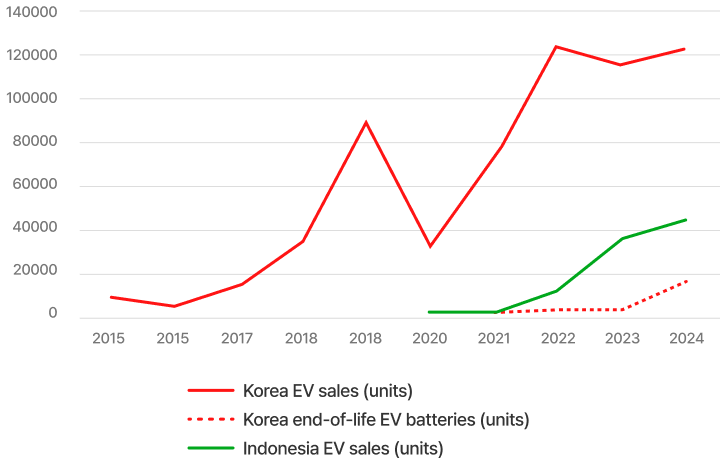
Source: The KSP Final Report
The Hidden Reef: Indonesia at the Crossroads of Waste and Resources
Spent batteries are "Urban Mines" rich in critical minerals such as lithium and nickel, as well as strategic resources that can gain a second life through Energy Storage Systems (ESS). However, when the project was initiated, KSP researchers identified three major bottlenecks facing Indonesia in capitalizing on this potential.
Under regulations set by the Indonesian Ministry of Environment, spent batteries are classified as high-risk 'B3 hazardous waste.' Consequently, stringent environmental permits are required across every stage—collection, transportation, storage, and processing—while no legal framework exists to recognize them as reusable 'circular resources.'
An Extended Producer Responsibility (EPR) system—which mandates recovery obligations for battery manufacturers and importers—was not implemented. As a result, massive volumes of end-of-life electronics and batteries are being illegally dismantled through informal collection networks known as Pemulung. This poses severe risks of fire and explosion, as well as heavy metal contamination of the soil.
As an archipelago comprising over 17,000 islands, transporting heavy spent batteries by sea to a single centralized, large-scale recycling facility is virtually impossible due to logistics costs and safety concerns. Furthermore, without a centralized control tower, regulatory authority is fragmented across multiple entities—including the Ministry of Environment, the Ministry of Industry, and the Ministry of Energy and Mineral Resources—making consistent policy implementation impossible.
| Collection Entity | Major Target Items | Key Features | Institutionalization Status | Commercial Value |
|---|---|---|---|---|
| Informal Collectors (Pemulung) |
PET, HDPE (High-Density Polyethylene), Paper, Metals, Cans, Wires and Cables, etc. | High-value recyclables | Informal | Primarily high-value |
| Waste Banks (Bank Sampah) |
PET, HDPE, Paper, Metals, Cans, Wires and Cables, etc. | Community-based participation, Point rewards | Semi-institutionalized (Varies by region) |
- |
| Environmental Agencies (DLH) |
Mixed Waste (Including E-waste) |
Operating collection vehicles, Linked to landfills | Institutionalized | Primarily high-value |
| Intermediate Storage Facilities (TPST) |
Mixed Waste (Including E-waste) |
Focused on sorting and segregation, Partial direct collection | Public Facilities | Primarily high-value |
| Corporate Takeback (EPR) |
PET Beverage Bottles, HDPE, etc. | Operating Buy-back, Refill Station | Pilot Stage | - |
Source: The KSP Final Report
Why Korea?: A Trailblazer Setting the Standard for Life-Cycle Management
To address these national challenges, the Ministry of National Development Planning of Indonesia (BAPPENAS) and the Global Green Growth Institute (GGGI) sought assistance from South Korea, which had proactively established a comprehensive response framework.
South Korea operates the 'Allbaro System', a digital platform that tracks the entire waste management process in real time—from generation and transportation to final disposal.
In particular, the experience of Jeju Special Self-Governing Province—which spearheaded EV adoption within the geographically constrained environment of an island—served as an ideal reference for Indonesia. Korea established the Jeju EV Battery Industrialization Center to recover batteries from auto scrapyards, precisely evaluate their State of Health (SOH), and either reuse them in Energy Storage Systems (ESS) or recycle them into Black Mass based on their condition grade, thereby successfully demonstrating a complete 'life-cycle resource circulation ecosystem.'
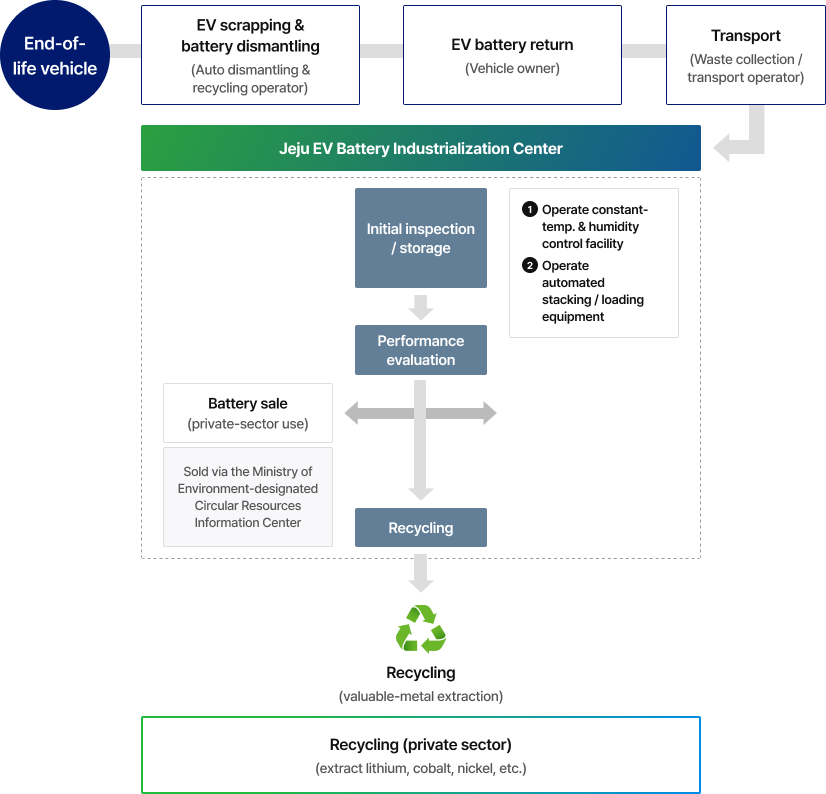
Source: The KSP Final Report
Our Solution: The Birth of a Customized 3-Phase Roadmap for Indonesia
Based on Korea's extensive experience, the KSP research team thoroughly analyzed Indonesia's administrative system, the characteristics of its battery chemical compositions, and the logistical limitations of its island geography to finalize a 'Short-, Medium-, and Long-term Roadmap' tailored for local application.
Phase 1. Short-Term
Government-Led Institutional Overhaul and Public-Based Pilot Projects
Legislation of Circular Resources
We proposed establishing a legal basis to either grant used batteries an exception from B3 (hazardous and toxic) waste classification or redefine them as 'recyclable resources.'
Integrated Support Center Model
Benchmarking Korea's Future Waste Resource Regional Collection Centers, we recommended building public infrastructure that provides a comprehensive all-in-one process for 'collection–discharging–basic inspection–safe storage.'
Phase 2. Medium-Term
Introducing Private Investment and Establishing a Role-Sharing Structure
Mobile Diagnostic Model
To overcome the geographical challenges of an archipelago consisting of numerous islands, we proposed a decentralized system. Instead of constructing large-scale facilities, this approach introduces small-scale storage sites at regional hubs equipped with 'mobile battery diagnostic equipment.'
SNI-Linked Safety Certification
We designed a regulatory sandbox that adds residual battery performance evaluation criteria to the Indonesian National Standard (SNI), ensuring that only certified repurposed products (such as Energy Storage Systems) can be distributed in the market.
Phase 3. Long-Term
Establishment of a Market-Autonomous, Private Sector-Led Ecosystem
Full-Scale Implementation of EPR
We outlined the introduction of a comprehensive Extended Producer Responsibility (EPR) system, which transfers the responsibility for battery recovery from the public sector over to automakers and battery manufacturers.
Digital Traceability
We set a long-term goal to build a 'Battery Passport' system that manages all life-cycle data, from a battery's production to its final disposal, using blockchain and cloud-based technologies.
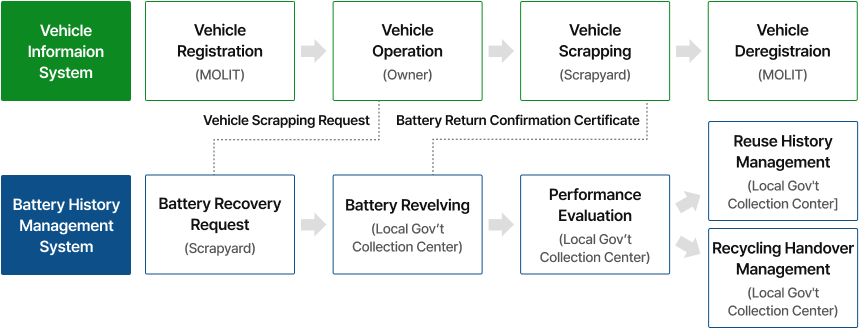
Source: The KSP Final Report
Deep Dive
Customized Strategy Based on Battery Chemistry
The research team separated the economic viability of Chinese LFP (Lithium Iron Phosphate) batteries dominating the Indonesian market and Korean NCM (Nickel-Cobalt-Manganese) batteries to validate feasibility.
NCM Batteries
NCM batteries containing nickel and cobalt have metal recovery value of approximately $8,700 per ton, making private-sector profitability sufficiently viable.
LFP Batteries
Conversely, LFP batteries have lower recovery value (approximately $3,170 per ton), making voluntary recycling difficult; therefore, national EPR regulations and financial incentives (subsidies) must accompany implementation.
The Beginning of Change: Policy Moves the Field
The recommendations based on thorough analysis played a pivotal role in shifting the perspectives of Indonesian policymakers.
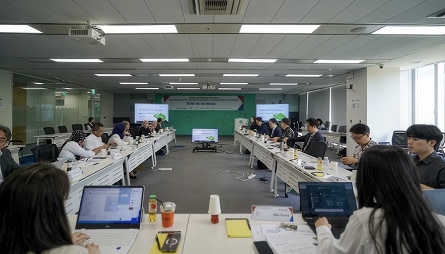
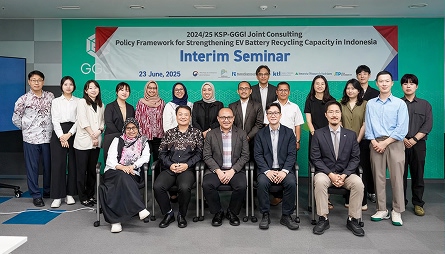
Centered around BAPPENAS, previously fragmented government ministries, such as the Ministry of Environment, Ministry of Industry, and Ministry of Energy, gathered to jointly commence a multi-ministerial cooperation framework based on the roadmap proposed by KSP. Spanning beyond merely functioning as pure regulatory bodies, they united around a shared goal of 'fostering green industries.'
Indonesian policymakers participating in the capacity-building training program witnessed Korea's reused battery safety inspection institutions and private recycling facilities (specifically black mass extraction processes) firsthand, experiencing the tangible reality of a circular economy.
The three-stage roadmap presented by South Korea was not simply about copying laws from a developed nation. It was a sophisticated compass that accurately addressed our logistical limitations as an archipelago, as well as the unique characteristics of our market dominated by LFP batteries. We now have the conviction that spent batteries are no longer an unmanageable headache, but a new source of economic value for Indonesia.

Source: Interim Report and Policy Practitioners' Workshop Results Report
An Unstoppable Journey: From Policy to Technological Cooperation
This KSP project will serve as a catalyst for Indonesia to achieve its vision of '2060 Carbon Neutrality' and its 'National Medium-Term Development Plan (RPJMN 2025–2029).' Designing laws and institutional frameworks serves as a sturdy cornerstone for the overall success of the projects. The physical infrastructure and technical expertise required to safely discharge, dismantle, and extract metals from used-up batteries needs to be well-implemented as a common practice in the field.
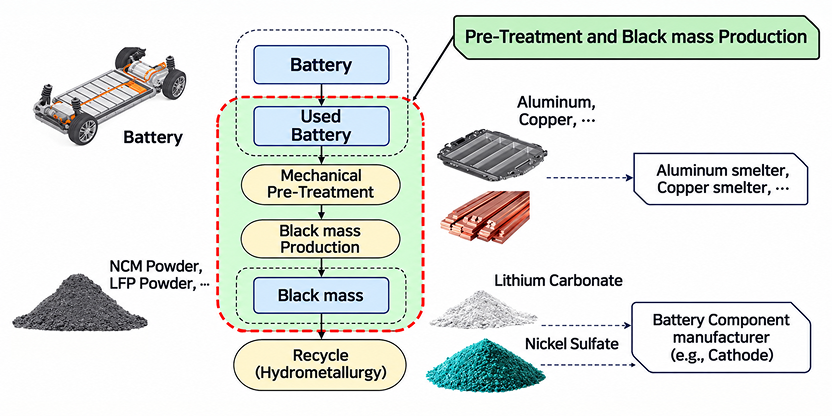
Accordingly, extending beyond mere policy recommendations, the KSP research team has officially proposed launching an 'EV Used Battery Recycling Pilot Project (ODA)' to directly establish Korea's advanced battery recycling technology on the ground in Indonesia.
Source: Interim Report and Policy Practitioners' Workshop Results Report
In order to establish local pilot facilities for key pretreatment processes, a specific blueprint has been constructed. This includes the installment of explosion-proof equipment for safe transport, setting up State of Health (SOH) testing and insulation resistance measurement devices, and building complete discharge infrastructure for fire prevention.
Innovative Korean battery diagnostics and recycling companies, such as Poen, Evacycle, and L&F, are already preparing to enter the local value chain by exploring joint ventures and strategic partnerships with local Indonesian enterprises.
This collaboration between South Korea and Indonesia stretches beyond merely refining environmental regulations. By connecting people, institutional frameworks, and innovative technologies, both nations are jointly pioneering a 'global battery circular ecosystem.'